

Your HVAC system affects indoor air quality by controlling ventilation, temperature, humidity, and filtration. When airflow is balanced and filters are clean, you dilute pollutants and capture particles before they circulate. If ducts leak, coils contaminate, or filters load up, dust and irritants build up. Humidity matters too: too dry can irritate airways, while excess moisture supports mold. Keep humidity near 30% to 50% and your system can perform much better, as the details below show.
Key Takeaways
- HVAC systems improve indoor air quality by ventilating stale air, filtering pollutants, and maintaining stable temperature and airflow.
- Dirty filters, leaky ducts, and contaminated coils reduce HVAC effectiveness and can spread dust, allergens, and moisture-related contaminants.
- Humidity strongly affects comfort and health; 30%–50% indoor humidity helps limit mold, dust mites, and airway irritation.
- Low humidity can dry mucosal surfaces and worsen nasal, throat, and lung irritation, while excess humidity encourages mold growth.
- Effective filtration captures particles through interception, impaction, and diffusion, but performance depends on filter type, airflow, and regular maintenance.
What Indoor Air Quality Really Means?

Indoor air quality refers to the condition of the air inside buildings and how it affects health, comfort, and performance. You assess it by identifying pollutant sources, airborne toxins, and ventilation strategies that influence exposure. Poor air quality can trigger health effects such as irritation, fatigue, or reduced concentration, while adequate fresh air supports occupant comfort and cognitive function. You should likewise consider air quality monitoring, as measurements reveal patterns that intuition misses. Indoor plants may modestly affect perception, but they don’t replace source control. Seasonal changes alter infiltration, humidity, and pollutant accumulation, so you need adaptive management. Effective evaluation balances energy efficiency with contaminant reduction, seeing that overventilation wastes resources and undermines stability. In commercial buildings, recirculation of air can introduce contaminants such as dust, biological growth, humidity, and water intrusion that compromise indoor environments. In practice, you judge IAQ by measurable conditions, not assumptions or appearance.
How HVAC Affects Indoor Air Quality?
HVAC systems shape indoor air quality by controlling ventilation, filtration, temperature, humidity, and air distribution. You influence pollutant exposure when your system exchanges stale indoor air with filtered outdoor air, diluting carbon dioxide, odors, and airborne particles. When HVAC efficiency stays high, the equipment delivers the intended airflow with less energy waste, so you maintain more stable conditions and stronger contaminant removal. Air circulation matters since well-balanced supply and return paths prevent stagnant zones where particles can accumulate. You likewise improve consistency when filters capture particulate matter before it recirculates through rooms. Temperature and humidity control further support IAQ by reducing conditions that favor discomfort and microbial growth. Professional air quality assessments can identify specific contaminants and moisture sources that your HVAC system may not adequately address on its own. In practice, your system serves as an engineered control layer, not just a comfort device.
What HVAC Problems Add Pollutants?

When your HVAC system has faults, it can add pollutants instead of removing them. You need disciplined HVAC maintenance to prevent internal pollutant sources from accumulating in coils, pans, and housings. Poor filter types let particulates bypass capture, while clogged media reduce system efficiency and weaken air circulation. Ventilation issues can likewise draw contaminants from attics, crawlspaces, or adjacent zones into the supply path. Professional environmental inspection and air quality support can identify hidden ventilation risks that compromise your indoor environment.
- Dirty filters
- Leaky ducts
- Contaminated coils
- Blocked condensate drains
Each fault degrades delivery, increases recirculation, and complicates odor control. You should inspect seals, verify airflow, and schedule duct cleaning when debris or biofilm appears. Precise diagnostics let you isolate failure points before they spread pollutants through occupied spaces.
Why Humidity Affects Indoor Air Quality?
Humidity shapes indoor air quality since it changes how particles, microbes, and chemical pollutants behave in enclosed spaces. You’ll see that Humidity levels alter deposition, evaporation, and human comfort, so precise Humidity measurement matters. Indoor Humidity sources include occupants, cooking, showers, and infiltration, each shifting local conditions. Effective Humidity control keeps your HVAC system within a narrow band, limiting irritants and stabilizing performance. Humidity effects likewise influence static electricity and airborne residence time. Maintaining proper humidity levels is particularly critical in educational facility environments, where students and staff spend extended periods in enclosed spaces and require optimal conditions for learning and productivity.
| Factor | IAQ impact |
|---|---|
| Low humidity | Raises irritation |
| High humidity | Changes particle behavior |
| Humidity sources | Add moisture load |
| Humidity measurement | Guides adjustment |
| Humidity control | Stabilizes conditions |
When you tune these variables, you improve filtration efficiency and reduce pollutant persistence without overcorrecting.
How Too Much Moisture Triggers Mold?

Excess moisture creates the conditions mold needs to colonize porous surfaces and spread indoors. When you let relative humidity stay heightened, you increase mold growth risk as spores germinate once surfaces remain damp long enough. You can interrupt that cycle with disciplined moisture control:
- Keep indoor humidity near 30%–50%.
- Repair leaks and condensation sources fast.
- Ventilate kitchens, baths, and laundry areas.
- Dry wet materials within 24–48 hours.
You should likewise inspect hidden cavities, since wall voids and duct insulation can trap moisture and accelerate colonization. By controlling vapor, airflow, and drying time, you reduce the biological advantage mold needs to establish colonies. That precision matters as prevention is always more effective than remediation. When prevention efforts fall short, post-remediation air testing verifies that contamination has been safely removed and indoor air quality restored to safe spore levels.
How Dry Air Affects Breathing and Comfort?
When indoor air is too dry, you can feel increased airway irritation since low humidity reduces moisture on the mucosal surfaces that line your nose and throat. You may likewise notice drier eyes, skin, and lips, along with a higher likelihood of discomfort during normal breathing. These effects can make your indoor environment feel less tolerable even when temperature and ventilation seem acceptable. Addressing moisture levels through indoor air quality services can help restore comfort and protect respiratory health in your home.
Dry Air Breathing Effects
Dry indoor air can irritate your airways by increasing moisture loss from the nose, throat, and bronchial passages, which makes breathing feel less comfortable and more effortful. You may notice dry air symptoms that signal disrupted moisture balance:
- nasal congestion from mucosal drying
- throat dryness that sharpens each breath
- lung irritation that can increase respiratory discomfort
- allergy triggers and asthma exacerbation in sensitive airways
When humidity stays low, your airway lining can’t trap particles as efficiently, so irritation rises. You might likewise see skin irritation and sleep disturbances since dehydration affects exposed tissues overnight. The result isn’t just nuisance; it’s measurable stress on airway function. Early detection of humidity imbalances through professional inspections can prevent these respiratory issues from escalating and support long-term indoor air quality management. Managing indoor humidity helps preserve mucosal defense, reduce inflammatory load, and keep breathing mechanics more stable.
Comfort Loss From Dryness
Beyond airway irritation, low indoor humidity likewise reduces day-to-day breathing comfort by making each breath feel less smooth and less efficient. You’ll often notice lower comfort levels first: your nose, throat, and lips dry out, and dryness symptoms like scratchiness or a tight chest can appear. These changes can amplify respiratory issues as dry mucosa filters and humidifies inhaled air less effectively. During seasonal changes, HVAC heating can push humidity below the comfort range, degrading air quality even when filtration is strong. To preserve humidity balance, you need moisture control that matches your space, occupancy, and climate. Professional janitorial programs can support indoor air quality by integrating duct cleaning and IAQ services alongside your HVAC maintenance to ensure optimal humidity management. If you ignore the trend, health impacts can include increased irritation, poorer sleep, and reduced tolerance for indoor air that should feel neutral.
How HVAC Filters Capture Airborne Particles?

When you move air through an HVAC filter, particles get captured by mechanisms such as interception, impaction, and diffusion, depending on their size and velocity. You’ll see that filter media efficiency depends on fiber density, pore structure, and airflow resistance, which together determine how many airborne particles the filter removes. As you compare filter types, you can assess how these variables shape overall indoor air quality. For comprehensive protection beyond mechanical filtration, consider pairing your HVAC system with clearance air testing to verify that air quality meets safe limits and to identify any additional contaminants that require attention.
Particle Capture Mechanics
HVAC filters capture airborne particles through three primary mechanisms: interception, inertial impaction, and diffusion. You can analyze them by particle size, air flow, and airflow dynamics. These capture mechanisms govern how particulate matter follows streamlines, deviates, or collides with fibers, changing filtration efficiency across filter types.
- Interception traps particles that graze a fiber.
- Inertial impaction forces larger particles to continue straight, causing particle impact.
- Diffusion improves capture of ultrafine particles as random motion increases contact.
- Dust accumulation raises resistance, so filter maintenance matters.
You should match filter types to your system’s air flow to preserve performance. In practice, you’ll see efficiency shift as loading changes pore geometry and local velocity fields, altering how particles enter, rebound, or stay attached within the matrix. Proper filtration is essential for indoor air quality assessments that evaluate your system’s effectiveness in maintaining a healthy environment.
Filter Media Efficiency
Filter media efficiency determines how well a filter removes airborne particles at a given airflow and loading condition. You should compare filter types by filter ratings, filter materials, and filter technology, as each changes pressure drop and capture efficiency. | Variable | Effect | Action | |—|—|—| | Filter placement | Affects bypass risk | Seal the rack | | Filter maintenance | Controls loading | Replace on schedule | | Filter lifespan | Declines as dust accumulates | Track resistance | Higher filter effectiveness often requires tighter media or electrostatic design, but you must match filter selection to fan capability. If you pursue filter upgrades, verify compatibility, then measure airflow after installation. Humidity and debris alter performance, so your filter maintenance plan should preserve rated efficiency without shortening filter lifespan.
Which Filters Work Best for Cleaner Air?
Which filters clean indoor air most effectively depends on both the particle size you need to capture and your system’s airflow capacity. For maximum air quality, you should compare filtration technology by MERV ratings and pressure drop.
- HEPA filters deliver the highest allergen reduction, but they often exceed residential airflow limits.
- Activated carbon targets gases and odors, yet it won’t trap fine particulates well.
- UV purification can suppress biological contamination, but it works best as a supplement, not a primary filter.
- Track filter lifespan and schedule filter replacement before loading degrades performance.
You’ll get cleaner results when you match the filter to the blower’s tolerance and inspect filter maintenance routinely. In practice, the best choice balances capture efficiency, energy use, and system compatibility without sacrificing steady air quality.
How to Balance HVAC, Humidity, and Filtration?
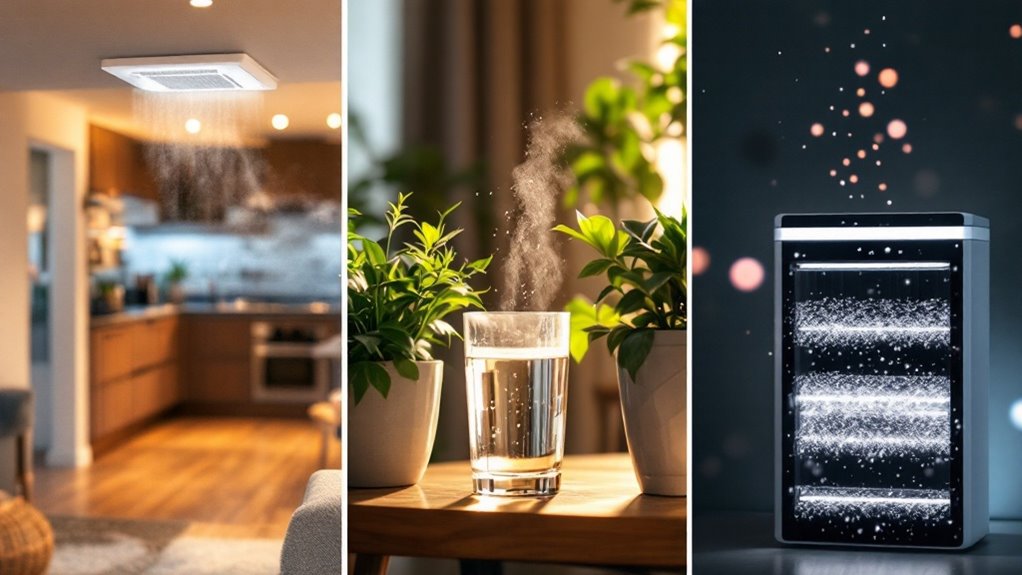
A good air-cleaning setup works only when airflow, moisture control, and particle capture stay in balance, as each one affects the others. You need enough airflow to move conditioned air through the filter without excessive pressure drop, but you additionally need humidity control techniques that keep indoor moisture in the 40% to 60% range. If humidity climbs too high, particles agglomerate, biological growth accelerates, and filtration loads increase. If it falls too low, dust stays airborne longer. Use HVAC optimization strategies to match fan speed, duct capacity, and filter resistance so the system maintains design airflow. Then select filtration that captures fine particles without starving the blower. When you align these variables, you improve air quality, protect equipment, and stabilize indoor comfort.
Simple Ways to Improve Indoor Air Quality?
You can improve indoor air quality by upgrading air filters to a higher-efficiency rating that captures smaller particulate matter. You should likewise control humidity levels within the recommended range, since excess moisture supports microbial growth and low humidity can increase airborne irritation. Regular HVAC maintenance helps keep airflow, filtration, and system performance within specification, reducing contaminant buildup.
Upgrade Air Filters
Upgrading air filters can greatly improve indoor air quality by capturing finer airborne particles before they circulate through your HVAC system. You should treat filter upgrades as a performance variable, not an accessory. Select a higher-efficiency rating that matches your equipment’s pressure limits, then verify fit to prevent bypass leakage.
- Compare MERV ratings against your system’s specifications.
- Inspect filters monthly for loading and deformation.
- Replace them on schedule, or sooner under heavy use.
- Confirm proper airflow after each change.
Consistent filter maintenance preserves capture efficiency and reduces recirculation of dust, pollen, and soot. If you skip maintenance, even strong filter upgrades lose effectiveness. By managing resistance and replacement intervals, you improve particulate control without sacrificing system stability or fan performance.
Control Humidity Levels
When indoor humidity drifts outside the 30–50% range, moisture can accelerate mold growth, increase dust mite activity, and make airborne contaminants more persistent. You should treat humidity as a control variable, not a comfort metric. Use humidity monitoring to verify conditions in living zones, closets, and below-grade rooms, as localized pockets often differ from the average. If readings stay high, apply dehumidification techniques such as condensate removal, targeted moisture extraction, and controlled ventilation balance. If readings fall too low, add moisture conservatively to avoid drying mucosa and suspending particulates. Track trends across seasons, occupancy shifts, and weather events so you can correct the cause, not just the symptom. Precise control reduces biological load and improves particle behavior indoors.
Maintain HVAC Systems
Humidity control works best when your HVAC system can hold setpoints accurately and move air consistently. You should treat system maintenance as a control strategy, not a chore. Use routine inspections to catch drift, leaks, and sensor errors before they degrade indoor air quality or energy efficiency.
- Replace filters on schedule; filter replacement stabilizes pressure drop and captures particulates.
- Verify airflow optimization at registers, returns, and dampers so distribution stays balanced.
- Schedule duct cleaning when contamination or buildup raises resistance and recirculates debris.
- Plan equipment upgrades and system troubleshooting when performance data show persistent faults.
When you maintain components methodically, you reduce load, improve filtration, and preserve humidity control. That discipline keeps your building cleaner, healthier, and easier to manage over time.
Frequently Asked Questions
How Often Should HVAC Ducts Be Professionally Cleaned?
You should professionally clean your HVAC ducts every 3 to 5 years, unless you notice mold, dust buildup, or pests; duct cleaning importance and HVAC maintenance tips help you adjust frequency based on system conditions.
Can Indoor Plants Improve Air Quality Significantly?
No, indoor plants won’t greatly improve air quality; that’s a 21st-century myth. You’ll get modest plant benefits, but air purification from foliage is negligible versus ventilation, filtration, and source control in your space.
Do Air Purifiers Replace the Need for HVAC Filtration?
No, you don’t replace HVAC filtration with air purifiers; you supplement it. Air purifier effectiveness depends on room coverage, while HVAC system integration continuously captures circulating particulates, reducing load and improving whole-home air quality.
What Signs Indicate Carbon Monoxide From HVAC Equipment?
You’ll notice carbon monoxide symptoms—headache, dizziness, nausea, confusion—often with no smell. Statistics show 400+ U.S. deaths yearly. Follow HVAC maintenance tips: inspect combustion vents, test CO alarms, and service burners regularly.
How Can Ventilation Rates Affect Indoor Pollutant Buildup?
Higher ventilation rates dilute and exhaust indoor pollutants faster, limiting buildup from pollutant sources; lower rates let contaminants accumulate, especially if ventilation efficiency drops. You’ll improve air quality by matching airflow to occupancy and source strength.
Conclusion
By managing HVAC performance, humidity, and filtration together, you improve indoor air quality at the source. Your system can move, clean, and condition air effectively, but only if it is properly maintained and correctly sized. Why let dust, moisture, and microbial growth reduce air quality when balanced controls can limit them? You can reduce pollutants, stabilize comfort, and protect health by monitoring airflow, humidity, and filter efficiency as a single, integrated system.